Future optical computers and communication networks will need components that can switch and process data using light alone, avoiding the delays caused by converting between optical and electronic signals. Tiny ring-shaped structures known as microresonators are promising building blocks for such technology, because they can concentrate light intensities high enough for nonlinear effects to emerge, even at modest input powers.
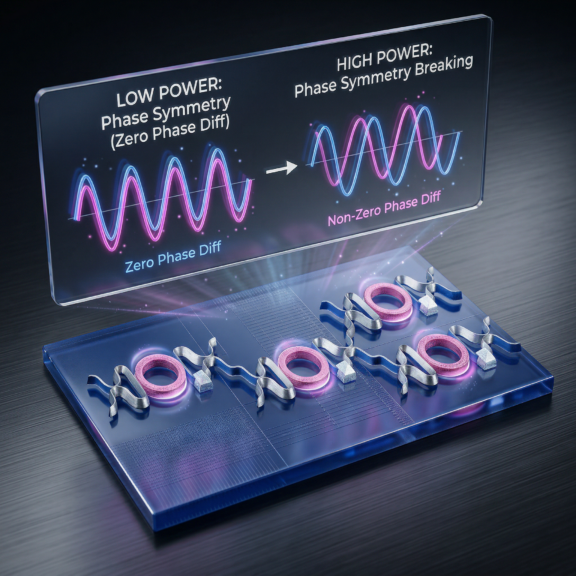
Researchers at the Max Planck Institute for the Science of Light and Friedrich-Alexander-Universität Erlangen-Nürnberg have now uncovered a previously unknown aspect of how counter-propagating light behaves in these devices, and turned it into a working optical switch. The team discovered that the phases of the counter-propagating fields undergo their own symmetry breaking, a phenomenon not previously identified. In their experiments, Alekhya Ghosh, Arghadeep Pal, Shuangyou Zhang, Lewis Hill, Toby Bi, and FAU LMQ member Pascal Del’Haye send laser light in both directions through a microresonator. At low power, the two output beams cancel each other out when recombined at a beam splitter, no signal gets through. Above a critical power, however, spontaneous symmetry breaking causes the two circulating fields to develop unequal intensities and phases. This disrupts the cancellation at the output port, and light suddenly appears, the switch turns “ON.” Building on these effects, the authors propose designs for integrated all-optical logic gates that could form the basis of photonic computing circuits.
For more information, see the original publication in Laser & Photonics Reviews:
Phase Symmetry Breaking of Counterpropagating Light in Microresonators for Switches and Logic Gates
Alekhya Ghosh, Arghadeep Pal, Shuangyou Zhang, Lewis Hill, Toby Bi, Pascal Del’Haye
Laser & Photonics Reviews 20, e01500 (2026)
AI was used for the preparation of the cover image.

Future optical computers and communication networks will need components that can switch and process data using light alone, avoiding the delays caused by converting between optical and electronic signals. Tiny ring-shaped structures known as microresonators are promising building blocks for such technology, because they can concentrate light intensities high enough for nonlinear effects to emerge, even at modest input powers.
Researchers at the Max Planck Institute for the Science of Light and Friedrich-Alexander-Universität Erlangen-Nürnberg have now uncovered a previously unknown aspect of how counter-propagating light behaves in these devices, and turned it into a working optical switch. The team discovered that the phases of the counter-propagating fields undergo their own symmetry breaking, a phenomenon not previously identified. In their experiments, Alekhya Ghosh, Arghadeep Pal, Shuangyou Zhang, Lewis Hill, Toby Bi, and FAU LMQ member Pascal Del’Haye send laser light in both directions through a microresonator. At low power, the two output beams cancel each other out when recombined at a beam splitter, no signal gets through. Above a critical power, however, spontaneous symmetry breaking causes the two circulating fields to develop unequal intensities and phases. This disrupts the cancellation at the output port, and light suddenly appears, the switch turns “ON.” Building on these effects, the authors propose designs for integrated all-optical logic gates that could form the basis of photonic computing circuits.
For more information, see the original publication in Laser & Photonics Reviews:
Phase Symmetry Breaking of Counterpropagating Light in Microresonators for Switches and Logic Gates
Alekhya Ghosh, Arghadeep Pal, Shuangyou Zhang, Lewis Hill, Toby Bi, Pascal Del’Haye
Laser & Photonics Reviews 20, e01500 (2026)
AI was used for the preparation of the cover image.