Quantum computers have the potential to solve certain problems much faster than classical computers, but they are also very sensitive to errors. Quantum error correction (QEC) is needed to keep errors in check. Unfortunately, some errors can spread in ways that QEC cannot fix. To handle this, fault-tolerant protocols use special “flag qubits”, quantum bits that signal when dangerous errors appear. Until now, most of these protocols have been designed by hand, often without considering the limits of real quantum hardware. In the work of Remmy Zen and others in the group of Florian Marquardt, they tackle this problem by using reinforcement learning, a branch of artificial intelligence (AI), to automatically design fault-tolerant quantum circuits.
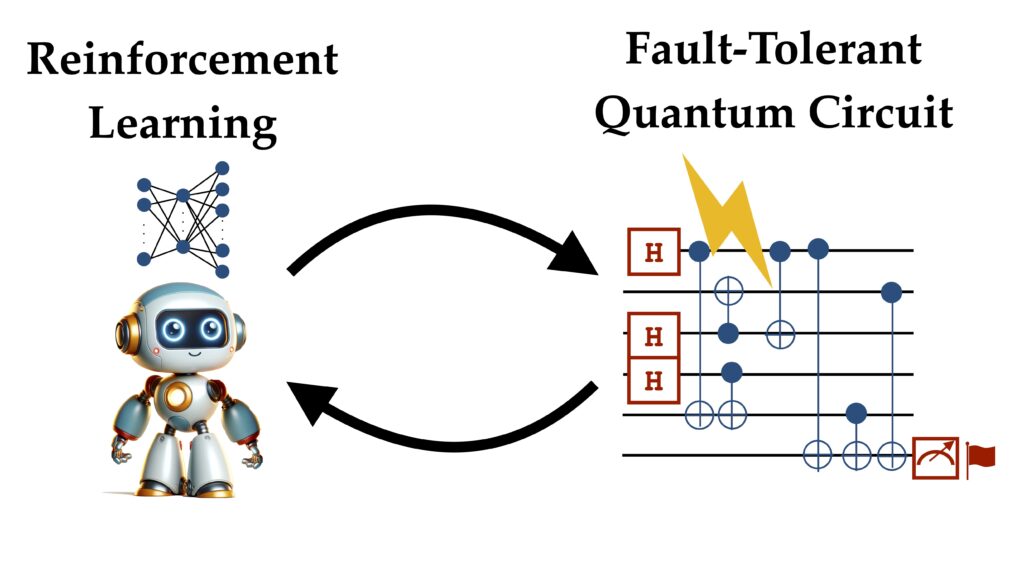
Reinforcement learning has already shown great success in mastering difficult games and tasks by finding strategies beyond those developed by humans. They apply reinforcement learning to the key challenge of preparing logical quantum states in a fault-tolerant way, which is the first step of QEC. The approach allows the AI to explore many possible circuit designs and learn which ones are most efficient while respecting hardware constraints. In doing so, the method discovers circuits that require fewer gates and flag qubits than the best human-designed circuits, as well as entirely new circuit structures.
For more information, see the publication in Physical Review X:
Quantum Circuit Discovery for Fault-Tolerant Logical State Preparation with Reinforcement Learning
Remmy Zen, Jan Olle, Luis Colmenarez, Matteo Puviani, Markus Müller, Florian Marquardt
Phys. Rev. X 15, 041012 (2025)

Quantum computers have the potential to solve certain problems much faster than classical computers, but they are also very sensitive to errors. Quantum error correction (QEC) is needed to keep errors in check. Unfortunately, some errors can spread in ways that QEC cannot fix. To handle this, fault-tolerant protocols use special “flag qubits”, quantum bits that signal when dangerous errors appear. Until now, most of these protocols have been designed by hand, often without considering the limits of real quantum hardware. In the work of Remmy Zen and others in the group of Florian Marquardt, they tackle this problem by using reinforcement learning, a branch of artificial intelligence (AI), to automatically design fault-tolerant quantum circuits.
Reinforcement learning has already shown great success in mastering difficult games and tasks by finding strategies beyond those developed by humans. They apply reinforcement learning to the key challenge of preparing logical quantum states in a fault-tolerant way, which is the first step of QEC. The approach allows the AI to explore many possible circuit designs and learn which ones are most efficient while respecting hardware constraints. In doing so, the method discovers circuits that require fewer gates and flag qubits than the best human-designed circuits, as well as entirely new circuit structures.
For more information, see the publication in Physical Review X:
Quantum Circuit Discovery for Fault-Tolerant Logical State Preparation with Reinforcement Learning
Remmy Zen, Jan Olle, Luis Colmenarez, Matteo Puviani, Markus Müller, Florian Marquardt
Phys. Rev. X 15, 041012 (2025)