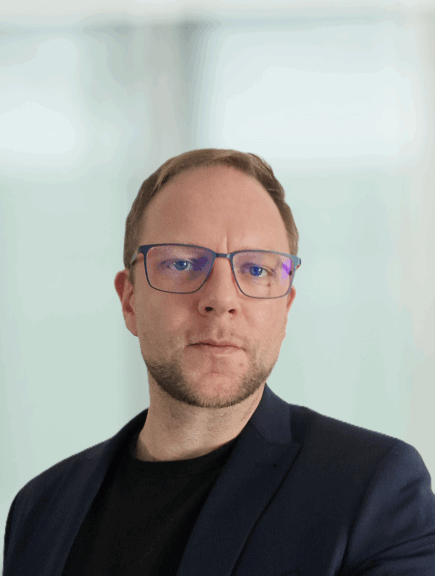
In this FAU LMQ People Spotlight, we interviewed our member Daniel Scherer, who leads the “Quantum Compilation” research group at the Fraunhofer Institute for Integrated Circuits (IIS) in Nuremberg since September 2024.
What is your research topic?
The research of the “Quantum Compilation” group is centered around the compilation layer of the quantum computing technology stack. As with classical computers, compilation can briefly be described as the process of translating a high-level description of a program into a set of instructions that can be executed at the hardware level. We focus on optimized compilation, such that the execution time of quantum algorithms on hardware, but also resource consumption, such as the number of qubits or costly gate operations, is minimized. This is tightly integrated with our research on lost-cost quantum error correction and distributed quantum computing. Being hosted by the department for Machine Intelligence at Fraunhofer IIS, we often employ state-of-the-art machine learning methods for tackling a range of complex problems.
How is your research linked to the research foci of the FAU LMQ?
As part of the Munich Quantum Valley initiative, we contribute to the development of the Munich Quantum Software Stack. As a regional player for the research and development of quantum software, we complement the research activities already represented within FAU LMQ, which have a strong focus on quantum technologies and quantum computing. Our core topics connect deeply to quantum control, the theory of quantum error correction, quantum communication and hardware-oriented computer science.
Why exactly this topic/these topics?
While research labs and hardware vendors pursue ambitious roadmaps towards realizing scalable, fault-tolerant quantum computers, these machines will only ever be useful with the corresponding software. We are working towards providing key components for the compilation layer of the software stack, which are crucial for resource efficiency and scalability.
Who in the Profile Center do you hope to collaborate with in the future?
In the past, we were already enjoying very fruitful collaboration with Michael Hartmann and Gerhard Wellein and have always participated actively in the “Machine Learning for Quantum Technology” Workshops organized by Florian Marquardt’s research group at the Max Planck Institute for the Science of Light. Beyond the strengthening of these ties, I hope to foster new connections with Christoph Marquardt and Susanne Naegele-Jackson to further our research on distributed quantum computing, and with Christopher Eichler regarding research on quantum error correction.
When I am not working as a scientist, then …
I am researching other things.
Do you have a secret talent?
I excel at speedcubing [*] in slow motion. Eventually, I want to move on to the quantum version of Rubik’s cube.
[*] https://de.wikipedia.org/wiki/Speedcubing
What does a typical day in your working life look like?
As a head of the “Quantum Compilation” research group, I typically have to switch roles very often through the course of the day: from manager to troubleshooter to strategist to business developer to researcher to social media influencer…
Where do you see the FAU LMQ in 5 or 10 years?
With FAU LMQ I see the great opportunity to connect regional players and to build a local quantum research and technologies ecosystem with global visibility.

In this FAU LMQ People Spotlight, we interviewed our member Daniel Scherer, who leads the “Quantum Compilation” research group at the Fraunhofer Institute for Integrated Circuits (IIS) in Nuremberg since September 2024.
What is your research topic?
The research of the “Quantum Compilation” group is centered around the compilation layer of the quantum computing technology stack. As with classical computers, compilation can briefly be described as the process of translating a high-level description of a program into a set of instructions that can be executed at the hardware level. We focus on optimized compilation, such that the execution time of quantum algorithms on hardware, but also resource consumption, such as the number of qubits or costly gate operations, is minimized. This is tightly integrated with our research on lost-cost quantum error correction and distributed quantum computing. Being hosted by the department for Machine Intelligence at Fraunhofer IIS, we often employ state-of-the-art machine learning methods for tackling a range of complex problems.
How is your research linked to the research foci of the FAU LMQ?
As part of the Munich Quantum Valley initiative, we contribute to the development of the Munich Quantum Software Stack. As a regional player for the research and development of quantum software, we complement the research activities already represented within FAU LMQ, which have a strong focus on quantum technologies and quantum computing. Our core topics connect deeply to quantum control, the theory of quantum error correction, quantum communication and hardware-oriented computer science.
Why exactly this topic/these topics?
While research labs and hardware vendors pursue ambitious roadmaps towards realizing scalable, fault-tolerant quantum computers, these machines will only ever be useful with the corresponding software. We are working towards providing key components for the compilation layer of the software stack, which are crucial for resource efficiency and scalability.
Who in the Profile Center do you hope to collaborate with in the future?
In the past, we were already enjoying very fruitful collaboration with Michael Hartmann and Gerhard Wellein and have always participated actively in the “Machine Learning for Quantum Technology” Workshops organized by Florian Marquardt’s research group at the Max Planck Institute for the Science of Light. Beyond the strengthening of these ties, I hope to foster new connections with Christoph Marquardt and Susanne Naegele-Jackson to further our research on distributed quantum computing, and with Christopher Eichler regarding research on quantum error correction.
When I am not working as a scientist, then …
I am researching other things.
Do you have a secret talent?
I excel at speedcubing [*] in slow motion. Eventually, I want to move on to the quantum version of Rubik’s cube.
[*] https://de.wikipedia.org/wiki/Speedcubing
What does a typical day in your working life look like?
As a head of the “Quantum Compilation” research group, I typically have to switch roles very often through the course of the day: from manager to troubleshooter to strategist to business developer to researcher to social media influencer…
Where do you see the FAU LMQ in 5 or 10 years?
With FAU LMQ I see the great opportunity to connect regional players and to build a local quantum research and technologies ecosystem with global visibility.