Research in quantum physics education aims to inform quantum physics instruction with empirical evidence on students’ learning processes and conceptual challenges. This is especially relevant as today’s students are tomorrow’s quantum professionals who will shape emerging quantum technologies. Quantum physics education has developed a range of research-based teaching–learning concepts, many of which build on two-state approaches as effective entry points into quantum theory. Their key advantage is mathematical simplicity, making them accessible for instruction and directly connecting to a central concept of quantum information science: the qubit. However, despite their prominent role in the literature, there has been little comparative empirical evidence on how different two-state approaches affect students’ conceptual understanding. Quantum measurement provides a key test case, as it is central to quantum physics instruction and widely known to trigger persistent conceptual difficulties.
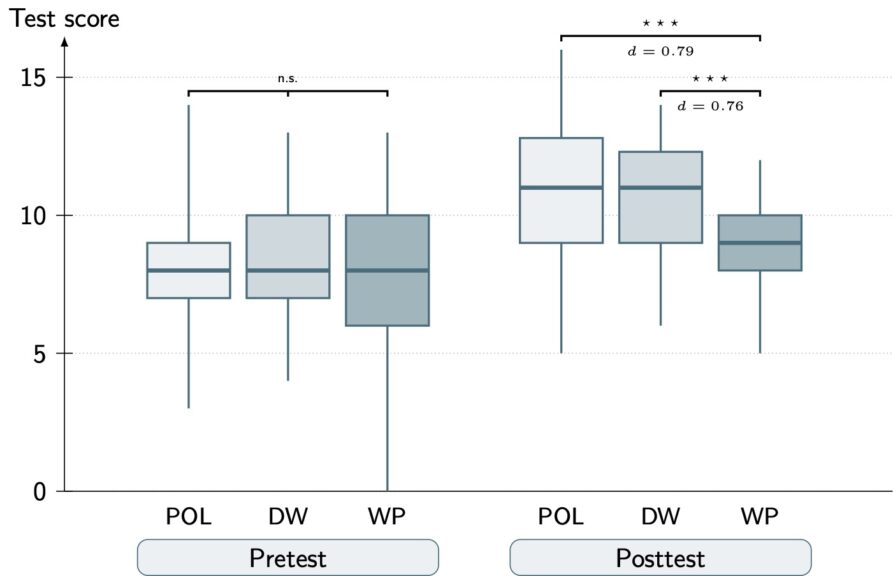
A quasi-experimental cluster study with 181 upper-secondary students, published as an Editor’s suggestion in Physical Review Physics Education Research, compared three inquiry-based instructional approaches using two-state quantum systems: a which-path-encoded single-photon context, a photon polarization context, and a double-well potential context. Students in all conditions improved, but learning gains were significantly higher in the polarization and double-well approaches than in the which-path-encoded single-photon approach (see figure). Response patterns suggest an important mechanism: polarization and double-well contexts more often supported a shift towards quantum thinking, whereas the which-path context left learners more frequently in mixed classical–quantum reasoning.
Taken together, the findings support several implications for quantum physics instruction: introducing quantum theory through two-state systems can provide an accessible mathematical entry point. However, instruction should clearly emphasize the model character, as quantum theory does not provide a space-time description of what “happens” between preparation and measurement. Finally, overly classical-mechanistic language should be avoided – especially in which-path contexts – in order to reduce mixed reasoning and promote more consistent quantum thinking.
This study was conducted as part of the DQC-2stap project, supported by the European Flagship.
For more information, see the publication in Physical Review Physics Education Research:
Investigating the effect of two-state approaches on students’ understanding of quantum measurement: A quasiexperimental field study
Kristóf Tóth, Sergej Faletič, Marisa Michelini, Gesche Pospiech, Andrea Betti, Marco Nicolini, Marco Parmiggiani, Joaquin Veith, and Philipp Bitzenbauer
Phys. Rev. Phys. Educ. Res. 21, 020142 (2025)

Research in quantum physics education aims to inform quantum physics instruction with empirical evidence on students’ learning processes and conceptual challenges. This is especially relevant as today’s students are tomorrow’s quantum professionals who will shape emerging quantum technologies. Quantum physics education has developed a range of research-based teaching–learning concepts, many of which build on two-state approaches as effective entry points into quantum theory. Their key advantage is mathematical simplicity, making them accessible for instruction and directly connecting to a central concept of quantum information science: the qubit. However, despite their prominent role in the literature, there has been little comparative empirical evidence on how different two-state approaches affect students’ conceptual understanding. Quantum measurement provides a key test case, as it is central to quantum physics instruction and widely known to trigger persistent conceptual difficulties.
A quasi-experimental cluster study with 181 upper-secondary students, published as an Editor’s suggestion in Physical Review Physics Education Research, compared three inquiry-based instructional approaches using two-state quantum systems: a which-path-encoded single-photon context, a photon polarization context, and a double-well potential context. Students in all conditions improved, but learning gains were significantly higher in the polarization and double-well approaches than in the which-path-encoded single-photon approach (see figure). Response patterns suggest an important mechanism: polarization and double-well contexts more often supported a shift towards quantum thinking, whereas the which-path context left learners more frequently in mixed classical–quantum reasoning.
Taken together, the findings support several implications for quantum physics instruction: introducing quantum theory through two-state systems can provide an accessible mathematical entry point. However, instruction should clearly emphasize the model character, as quantum theory does not provide a space-time description of what “happens” between preparation and measurement. Finally, overly classical-mechanistic language should be avoided – especially in which-path contexts – in order to reduce mixed reasoning and promote more consistent quantum thinking.
This study was conducted as part of the DQC-2stap project, supported by the European Flagship.
For more information, see the publication in Physical Review Physics Education Research:
Investigating the effect of two-state approaches on students’ understanding of quantum measurement: A quasiexperimental field study
Kristóf Tóth, Sergej Faletič, Marisa Michelini, Gesche Pospiech, Andrea Betti, Marco Nicolini, Marco Parmiggiani, Joaquin Veith, and Philipp Bitzenbauer
Phys. Rev. Phys. Educ. Res. 21, 020142 (2025)