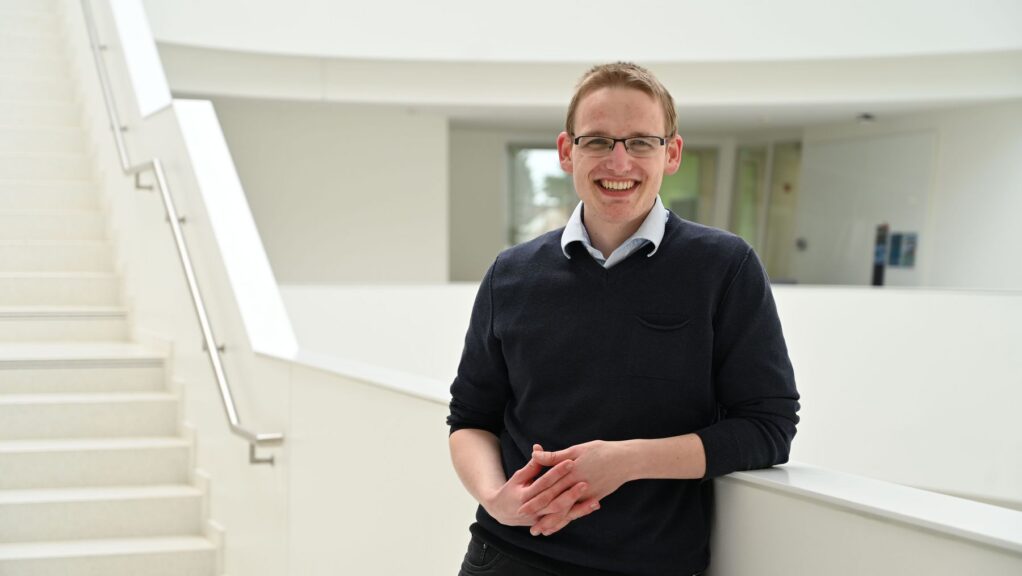
In this FAU LMQ People Spotlight, we interviewed the researcher Timo Eckstein, who is working as a PostDoc at the Chair for Quantum Theory since June 2020.
What is your research topic? What is your current role?
Typically, my research aims to study quantum algorithms, from conception and numerical tests to analytical error bounds and demonstrations tailored for near-term quantum hardware devices. For this, I follow the philosophy that incorporating additional structure, more specifically Hamiltonian symmetries, allows to outperform structure-unaware benchmark algorithms like Trotter-Suzuki formulas or Pauli-based measurements on relevant problem classes.
How is your research linked to the research foci of the FAU LMQ?
One of my recent works, “Large-scale simulations of Floquet physics on near-term quantum computers”, beautifully brings together all three directions of FAU LMQ: Light, Matter and Quantum technologies. In the project, we developed a quantum algorithm based on high-frequency expansion to simulate quantum systems that are periodically driven more efficiently. One can see this as foundational work for simulating light-matter interaction on a quantum computer in the future.
What do you find most fascinating in your research?
On an abstract level, I am still deeply amazed by how the shift in computational paradigm from a deterministic classical to a probabilistic quantum one can result in up to exponential speed-ups. In recent years, it has been truly motivating to see the incredible speed in which the best-in-class quantum hardware is improving. After all, the usefulness of quantum computers will be determined by what we can compute with them in practice, beyond what classical computers can do. Thus, I deeply believe that the perfect time for quantum algorithm research is NOW!
When I am not working at the FAU, then …
I like playing board games with friends quite a bit. It’s a welcoming contrast to working on a computer. From my teens, I kept up volunteering for the firefighter department at home. It’s a great way not to get trapped in the ivory tower.
Do you have a secret talent?
Well, physicists do not quite have a reputation for being social creatures. Nonetheless, I think I have done a decent job in both productively and harmoniously leading peers, for example, in the FAU Doctoral Representation.
What does a typical day in your working life look like?
That’s what I like about my job, it offers a diverse daily life. This could be reading literature, doing numerical simulations, coding, discussing with colleagues or communicating the science we do to the community and public. In contrast to computers, humans are pretty awful at multitasking. This is why I typically try to focus all my attention on one thing at a time and to do it well.
What are your plans for the future?
Solving once again the academic three-body problem, this time, hopefully, more long-term. Nonetheless, I appreciate a lot the ongoing stability and opportunity that the chair of quantum theory, supported by MQV and FAU LMQ, provides.
(Image on the top: Veronika Früh / Munich Quantum Valley)

In this FAU LMQ People Spotlight, we interviewed the researcher Timo Eckstein, who is working as a PostDoc at the Chair for Quantum Theory since June 2020.
What is your research topic? What is your current role?
Typically, my research aims to study quantum algorithms, from conception and numerical tests to analytical error bounds and demonstrations tailored for near-term quantum hardware devices. For this, I follow the philosophy that incorporating additional structure, more specifically Hamiltonian symmetries, allows to outperform structure-unaware benchmark algorithms like Trotter-Suzuki formulas or Pauli-based measurements on relevant problem classes.
How is your research linked to the research foci of the FAU LMQ?
One of my recent works, “Large-scale simulations of Floquet physics on near-term quantum computers”, beautifully brings together all three directions of FAU LMQ: Light, Matter and Quantum technologies. In the project, we developed a quantum algorithm based on high-frequency expansion to simulate quantum systems that are periodically driven more efficiently. One can see this as foundational work for simulating light-matter interaction on a quantum computer in the future.
What do you find most fascinating in your research?
On an abstract level, I am still deeply amazed by how the shift in computational paradigm from a deterministic classical to a probabilistic quantum one can result in up to exponential speed-ups. In recent years, it has been truly motivating to see the incredible speed in which the best-in-class quantum hardware is improving. After all, the usefulness of quantum computers will be determined by what we can compute with them in practice, beyond what classical computers can do. Thus, I deeply believe that the perfect time for quantum algorithm research is NOW!
When I am not working at the FAU, then …
I like playing board games with friends quite a bit. It’s a welcoming contrast to working on a computer. From my teens, I kept up volunteering for the firefighter department at home. It’s a great way not to get trapped in the ivory tower.
Do you have a secret talent?
Well, physicists do not quite have a reputation for being social creatures. Nonetheless, I think I have done a decent job in both productively and harmoniously leading peers, for example, in the FAU Doctoral Representation.
What does a typical day in your working life look like?
That’s what I like about my job, it offers a diverse daily life. This could be reading literature, doing numerical simulations, coding, discussing with colleagues or communicating the science we do to the community and public. In contrast to computers, humans are pretty awful at multitasking. This is why I typically try to focus all my attention on one thing at a time and to do it well.
What are your plans for the future?
Solving once again the academic three-body problem, this time, hopefully, more long-term. Nonetheless, I appreciate a lot the ongoing stability and opportunity that the chair of quantum theory, supported by MQV and FAU LMQ, provides.
(Image on the top: Veronika Früh / Munich Quantum Valley)