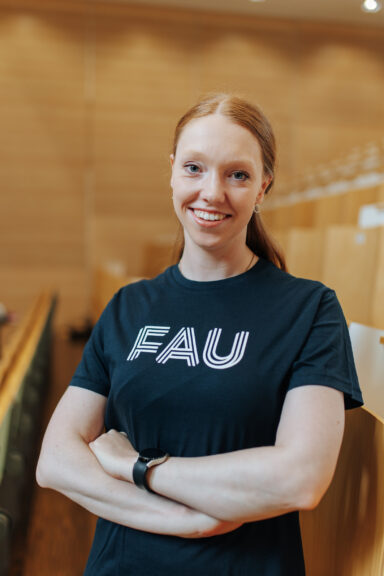
In this FAU LMQ People Spotlight, we interviewed our member Carolin Müller, who is assistant professor for the theory of electronically excited states at the department of chemistry and pharmacy and the Computer-Chemistry-Center, where she leads the Computational PhotoChemistry group since November 2023.
What is your research topic?
My research focuses on understanding and tailoring of light-induced molecular phenomena. Using quantum chemistry and cheminformatics, we aim to predict and analyse how molecules absorb light and undergo photophysical and photochemical transformations. The ultimate goal is to optimize these light-driven events to enhance molecular reactivity and efficiency of certain paths of interest.
How is your research linked to the research foci of the FAU LMQ?
I study photoexcited molecular dynamics, using computational methods to understand how molecules absorb and respond to light. These insights help inform quantum-optical applications and light-matter technologies.
Why exactly this topic/these topics?
Because light-driven processes operate on ultrafast timescales and involve subtle quantum effects, they offer both fundamental scientific challenges and great potential for innovation. Understanding them enables the rational design of more efficient, controllable, and sustainable photoactive systems.
Who in the Profile Center do you hope to collaborate with in the future?
In the future, I hope to expand collaborations focused on understanding how the excited-state properties of molecules, such as reactivity or acidity, are influenced by strong light-matter coupling e.g. in optical cavities.
When I am not working as a scientist, then …
I enjoy strategic board games, learning Japanese, and practicing Aikido.
Do you have a secret talent?
Turning results into “clear and tidy” figures.
What does a typical day in your working life look like?
My day usually starts with cycling to work and a good coffee, followed by focused research time, teaching, and meetings. It often ends with running simulations or writing tasks.
Where do you see the FAU LMQ in 5 or 10 years?
I see the FAU LMQ as an internationally visible hub for light-matter quantum technologies, tightly integrating theory, computation, and experiment.
(Image on the top: FAU / FATHER&SUN)

In this FAU LMQ People Spotlight, we interviewed our member Carolin Müller, who is assistant professor for the theory of electronically excited states at the department of chemistry and pharmacy and the Computer-Chemistry-Center, where she leads the Computational PhotoChemistry group since November 2023.
What is your research topic?
My research focuses on understanding and tailoring of light-induced molecular phenomena. Using quantum chemistry and cheminformatics, we aim to predict and analyse how molecules absorb light and undergo photophysical and photochemical transformations. The ultimate goal is to optimize these light-driven events to enhance molecular reactivity and efficiency of certain paths of interest.
How is your research linked to the research foci of the FAU LMQ?
I study photoexcited molecular dynamics, using computational methods to understand how molecules absorb and respond to light. These insights help inform quantum-optical applications and light-matter technologies.
Why exactly this topic/these topics?
Because light-driven processes operate on ultrafast timescales and involve subtle quantum effects, they offer both fundamental scientific challenges and great potential for innovation. Understanding them enables the rational design of more efficient, controllable, and sustainable photoactive systems.
Who in the Profile Center do you hope to collaborate with in the future?
In the future, I hope to expand collaborations focused on understanding how the excited-state properties of molecules, such as reactivity or acidity, are influenced by strong light-matter coupling e.g. in optical cavities.
When I am not working as a scientist, then …
I enjoy strategic board games, learning Japanese, and practicing Aikido.
Do you have a secret talent?
Turning results into “clear and tidy” figures.
What does a typical day in your working life look like?
My day usually starts with cycling to work and a good coffee, followed by focused research time, teaching, and meetings. It often ends with running simulations or writing tasks.
Where do you see the FAU LMQ in 5 or 10 years?
I see the FAU LMQ as an internationally visible hub for light-matter quantum technologies, tightly integrating theory, computation, and experiment.
(Image on the top: FAU / FATHER&SUN)