Color centers, which are point defects in solids that provide a characteristic photoluminescence signal, play a crucial role employed as qubits for quantum technological devices. Outside of basic research, however, the necessary tools for color center characterization and quantification with high throughput and rapid feedback, as required to support material and technology development, are lacking.
Neural networks and machine learning could be promising approaches for color center recognition and quantification on photoluminescence maps recorded with optical microscopes. Until now, the acquisition of suitable training data for such neural networks was an unsolved problem, especially when sample surfaces or interfaces are also involved: First, because it is a chicken-egg problem, and second, because of the tremendous amount of training needed.
Fraunhofer IISB and FAU Chair of Applied Physics (LAP) now joined their technological repertoire to provide a suitable solution. A novel approach for the fast and automated characterization of emitter distributions on photoluminescence maps was developed at IISB and the functionality was demonstrated with benchmark samples. The samples were fabricated using the unique low-dose low-energy ion irradiation capabilities at LAP.
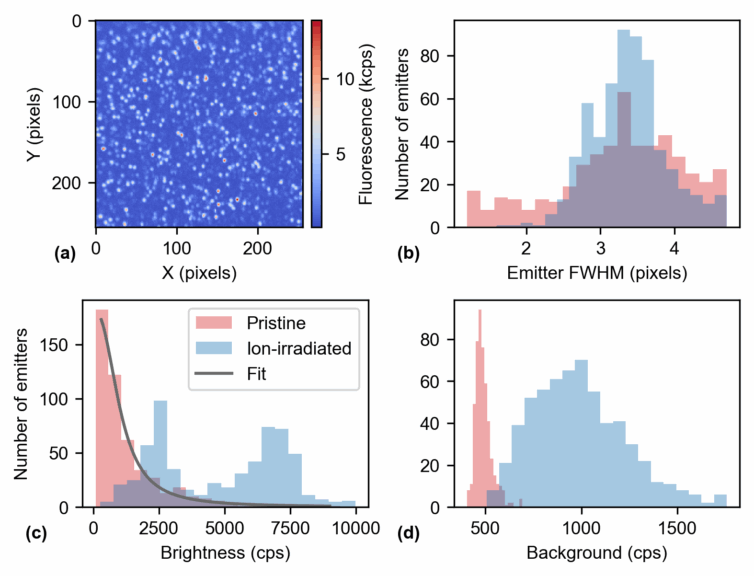
The results shed light on the characteristics of emitter distributions on pristine as well as ion irradiated samples with a special focus on surface proximity. Using the parameters extracted this way, the IISB developed and calibrated a software model for training data generation. This now allows to create the required training data for the machine learning application on a large scale.
Stay tuned as there will be news about machine learning-based color center quantification soon.
For more information, see their publication in Journal of Physics D: Applied Physics:
Parametrization of emitter photoluminescence towards AI-based color center quantification
C. Gobert, O. Reichenberger, P. Berwian, M. Krieger and J. Schulze
J. Phys. D: Appl. Phys. 58 265305, 2025

Color centers, which are point defects in solids that provide a characteristic photoluminescence signal, play a crucial role employed as qubits for quantum technological devices. Outside of basic research, however, the necessary tools for color center characterization and quantification with high throughput and rapid feedback, as required to support material and technology development, are lacking.
Neural networks and machine learning could be promising approaches for color center recognition and quantification on photoluminescence maps recorded with optical microscopes. Until now, the acquisition of suitable training data for such neural networks was an unsolved problem, especially when sample surfaces or interfaces are also involved: First, because it is a chicken-egg problem, and second, because of the tremendous amount of training needed.
Fraunhofer IISB and FAU Chair of Applied Physics (LAP) now joined their technological repertoire to provide a suitable solution. A novel approach for the fast and automated characterization of emitter distributions on photoluminescence maps was developed at IISB and the functionality was demonstrated with benchmark samples. The samples were fabricated using the unique low-dose low-energy ion irradiation capabilities at LAP.
The results shed light on the characteristics of emitter distributions on pristine as well as ion irradiated samples with a special focus on surface proximity. Using the parameters extracted this way, the IISB developed and calibrated a software model for training data generation. This now allows to create the required training data for the machine learning application on a large scale.
Stay tuned as there will be news about machine learning-based color center quantification soon.
For more information, see their publication in Journal of Physics D: Applied Physics:
Parametrization of emitter photoluminescence towards AI-based color center quantification
C. Gobert, O. Reichenberger, P. Berwian, M. Krieger and J. Schulze
J. Phys. D: Appl. Phys. 58 265305, 2025