What is your research topic? What is your current role?
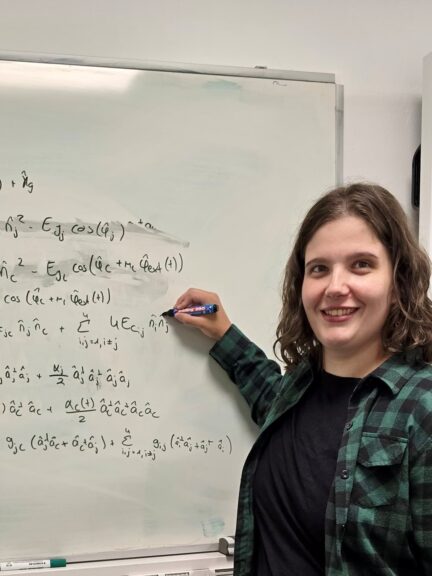
I am a PhD student at the Chair for Theoretical Physics II. My research focuses on the theory of parametrically driven superconducting quantum systems. In particular, I investigate how multi-qubit interactions can be engineered via a single coupling element, using parametric driving schemes to realize and control complex qubit-qubit interactions.
How is your research linked to the research foci of the FAU LMQ?
In superconducting quantum processors, information is encoded in quantum states of qubits. Parametric driving with tailored electromagnetic pulses provides a flexible tool to control and manipulate the interactions between these qubits. My work contributes to understanding and designing such driven interactions, which are essential for scalable quantum information processing.
What do you find most fascinating in your research?
What fascinates me most is how superconducting circuits provide a highly controllable platform for realizing quantum computers that are not only theoretically compelling but can actually be realized in the lab. In my research, I use parametrically driven electromagnetic fields to engineer and control interactions between qubits that would not naturally occur. To me, it feels like designing effective Hamiltonian interaction in real time, and this ability to “program” effective Hamiltonians at the hardware level makes the field both exciting and full of potential for novel applications.
When I am not working at the FAU, then …
I enjoy reading, painting/drawing and doing various water sports, like swimming or scuba diving.
Do you have a secret talent?
If I told you, it wouldn’t be a secret talent anymore …
What does a typical day in your working life look like?
A typical day usually involves a mix of theoretical work and collaboration. I spend much of my time performing analytical calculations, reading papers or running numerical simulations of superconducting circuits using Python. I also regularly discuss ideas and results with my colleagues, both in person and in Zoom meetings. During the semester, part of my work includes teaching responsibilities, such as preparing and holding tutorials for students.
What are your plans for the future?
Looking ahead, I hope to keep exploring the field of quantum technologies. I’m especially motivated by the idea that the concepts I study today – superconducting circuits and quantum processors – could form the foundation for the next generation of computing technologies. Whether I continue in academia or move into industry, I want to contribute to making these technologies more powerful and practical.

What is your research topic? What is your current role?
I am a PhD student at the Chair for Theoretical Physics II. My research focuses on the theory of parametrically driven superconducting quantum systems. In particular, I investigate how multi-qubit interactions can be engineered via a single coupling element, using parametric driving schemes to realize and control complex qubit-qubit interactions.
How is your research linked to the research foci of the FAU LMQ?
In superconducting quantum processors, information is encoded in quantum states of qubits. Parametric driving with tailored electromagnetic pulses provides a flexible tool to control and manipulate the interactions between these qubits. My work contributes to understanding and designing such driven interactions, which are essential for scalable quantum information processing.
What do you find most fascinating in your research?
What fascinates me most is how superconducting circuits provide a highly controllable platform for realizing quantum computers that are not only theoretically compelling but can actually be realized in the lab. In my research, I use parametrically driven electromagnetic fields to engineer and control interactions between qubits that would not naturally occur. To me, it feels like designing effective Hamiltonian interaction in real time, and this ability to “program” effective Hamiltonians at the hardware level makes the field both exciting and full of potential for novel applications.
When I am not working at the FAU, then …
I enjoy reading, painting/drawing and doing various water sports, like swimming or scuba diving.
Do you have a secret talent?
If I told you, it wouldn’t be a secret talent anymore …
What does a typical day in your working life look like?
A typical day usually involves a mix of theoretical work and collaboration. I spend much of my time performing analytical calculations, reading papers or running numerical simulations of superconducting circuits using Python. I also regularly discuss ideas and results with my colleagues, both in person and in Zoom meetings. During the semester, part of my work includes teaching responsibilities, such as preparing and holding tutorials for students.
What are your plans for the future?
Looking ahead, I hope to keep exploring the field of quantum technologies. I’m especially motivated by the idea that the concepts I study today – superconducting circuits and quantum processors – could form the foundation for the next generation of computing technologies. Whether I continue in academia or move into industry, I want to contribute to making these technologies more powerful and practical.