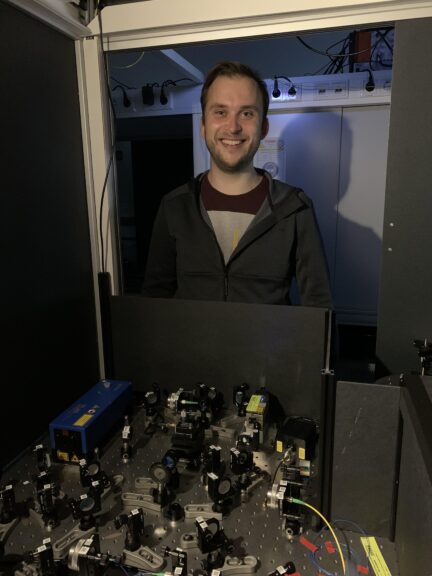
In this FAU LMQ People Spotlight, we interviewed the researcher Maximilian Hollendonner, who is working at the Institute of Applied Quantum Technologies (AQuT).
What is your research topic? What is your current role?
I am a PhD student at the workgroup of Prof. Dr. Roland Nagy, working with silicon vacancy centers in 4H Silicon Carbide. My work focuses on the interplay between the vacancy center and strain as well as phonon interaction of the SiC lattice.The central objective of our project is to understand how they influence spin properties and transition rates between different spin states of the silicon vacancy center.
How is your research linked to the research foci of the FAU LMQ?
Silicon vacancy centers in 4H Silicon Carbide are a very promising experimental platform for quantum technological applications. The central spin-3/2 of the color center is manipulated and read out via optical and microwave pulse sequences. In general, my research deals with the light-matter interaction of this quantum technological platform – experimental research closely related to FAU’s profile center of Light, Matter and Quantum Technologies.
What do you find most fascinating in your research?
Silicon vacancy centers are point defects, i.e. single missing atoms inside the 4H Silicon Carbide lattice. At the position of the former silicon atom, five electrons couple to an effective spin-3/2 system. It fascinates me that we are able to not only detect these single missing atoms, but also to manipulate and readout the spin of these color centers by detecting the emitted photons.
When I am not working at the FAU, then …
I enjoy playing the trumpet, e.g. at FAU Big Band. Besides this, I enjoy concerts, reading, sports and meeting friends.
Do you have a secret talent?
I would not call it secret, but I am a relatively open-minded person and enjoy working in collaborations with other researchers.
What does a typical day in your working life look like?
I try to spend most of my time focusing on my research. The challenges I hereby try to solve vary strongly from overcoming experimental obstacles and recording data on one side, to data analysis and understanding the underlying theoretical physics on the other side. I find it particularly fascinating that our research lies at the intersection between experimental and theoretical physics. Besides this, I am giving tutorials for students and supervise them for example during research internships or Bachelor / Master theses.
What are your plans for the future?
I hope to contribute to the transfer of quantum technologies towards real-world applications and could think of doing so in the future either on the academic or industry side.

In this FAU LMQ People Spotlight, we interviewed the researcher Maximilian Hollendonner, who is working at the Institute of Applied Quantum Technologies (AQuT).
What is your research topic? What is your current role?
I am a PhD student at the workgroup of Prof. Dr. Roland Nagy, working with silicon vacancy centers in 4H Silicon Carbide. My work focuses on the interplay between the vacancy center and strain as well as phonon interaction of the SiC lattice.The central objective of our project is to understand how they influence spin properties and transition rates between different spin states of the silicon vacancy center.
How is your research linked to the research foci of the FAU LMQ?
Silicon vacancy centers in 4H Silicon Carbide are a very promising experimental platform for quantum technological applications. The central spin-3/2 of the color center is manipulated and read out via optical and microwave pulse sequences. In general, my research deals with the light-matter interaction of this quantum technological platform – experimental research closely related to FAU’s profile center of Light, Matter and Quantum Technologies.
What do you find most fascinating in your research?
Silicon vacancy centers are point defects, i.e. single missing atoms inside the 4H Silicon Carbide lattice. At the position of the former silicon atom, five electrons couple to an effective spin-3/2 system. It fascinates me that we are able to not only detect these single missing atoms, but also to manipulate and readout the spin of these color centers by detecting the emitted photons.
When I am not working at the FAU, then …
I enjoy playing the trumpet, e.g. at FAU Big Band. Besides this, I enjoy concerts, reading, sports and meeting friends.
Do you have a secret talent?
I would not call it secret, but I am a relatively open-minded person and enjoy working in collaborations with other researchers.
What does a typical day in your working life look like?
I try to spend most of my time focusing on my research. The challenges I hereby try to solve vary strongly from overcoming experimental obstacles and recording data on one side, to data analysis and understanding the underlying theoretical physics on the other side. I find it particularly fascinating that our research lies at the intersection between experimental and theoretical physics. Besides this, I am giving tutorials for students and supervise them for example during research internships or Bachelor / Master theses.
What are your plans for the future?
I hope to contribute to the transfer of quantum technologies towards real-world applications and could think of doing so in the future either on the academic or industry side.