In this FAU LMQ People Spotlight, we interviewed the researcher Angela Montanaro, who is working at the Chair of Solid State Physics at the FAU.
What is your research topic? What is your current role?
I am an experimental condensed matter physicist. I’m currently a postdoctoral researcher working in the field of quantum materials. My research focuses on the study of light–matter interactions as a way to control the onset of emergent macroscopic phenomena in strongly correlated systems. More specifically, I’ve recently started to investigate the possibility of using cavity electrodynamics as a tuning knob to manipulate cooperative effects (like superconductivity) in complex systems. Ultimately, our goal is to demonstrate that by controlling the electromagnetic environment—rather than altering the material itself—we can create new quantum phases of matter.
How is your research linked to the research foci of the FAU LMQ?
The FAU LMQ Center brings together experts in quantum computing, sensing and materials. Cavity-controlled materials sit at this intersection and are an exceptional ground for interdisciplinary collaborations – both with other experimentalists and theorists. For example, we already have an ongoing collaboration with Philipp Hansmann and we plan on starting new ones.
What do you find most fascinating in your research?
The most exciting part is discovering new degrees of freedom. We already know how to control quantum materials with pressure, temperature or magnetic fields. Now we’re learning that the empty space around a material – the cavity and its quantum fluctuations – can be just as powerful. This opens up possibilities for remote control and for integrating switchable quantum materials into future quantum computers.
When I am not working at the FAU, then …
… I am working at MPL. But when I finally get home, I enjoy cooking, reading and sharing the rest of my day with family and friends.
Do you have a secret talent?
I’m quite good at table football. As a child, I used to challenge other kids in the south of Italy, now I usually compete with colleagues at international conferences.
What does a typical day in your working life look like?
I usually start my day with a coffee with my colleagues. This is probably the most important meeting of the day because many of the scientific discussions happen in the coffee room. Then my schedule is dictated by the most urgent thing to do among: collecting data in the lab, talking to students, analyzing data, writing papers, reviewing papers, preparing classes, supervising the renovation of our new labs, replying to emails.
What are your plans for the future?
My future plans are to keep exploring the mysteries of quantum materials and to mentor the next generation of physicists along the way. We’re only scratching the surface of what’s possible when you combine ultrafast spectroscopy with cavity quantum electrodynamics, and I’m excited to see where that curiosity will lead us.

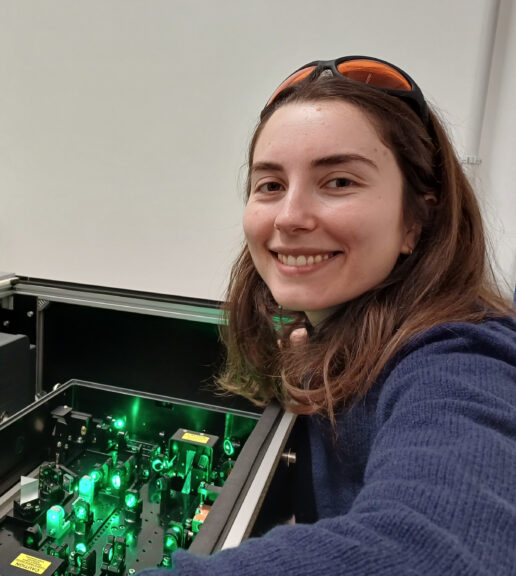
In this FAU LMQ People Spotlight, we interviewed the researcher Angela Montanaro, who is working at the Chair of Solid State Physics at the FAU.
What is your research topic? What is your current role?
I am an experimental condensed matter physicist. I’m currently a postdoctoral researcher working in the field of quantum materials. My research focuses on the study of light–matter interactions as a way to control the onset of emergent macroscopic phenomena in strongly correlated systems. More specifically, I’ve recently started to investigate the possibility of using cavity electrodynamics as a tuning knob to manipulate cooperative effects (like superconductivity) in complex systems. Ultimately, our goal is to demonstrate that by controlling the electromagnetic environment—rather than altering the material itself—we can create new quantum phases of matter.
How is your research linked to the research foci of the FAU LMQ?
The FAU LMQ Center brings together experts in quantum computing, sensing and materials. Cavity-controlled materials sit at this intersection and are an exceptional ground for interdisciplinary collaborations – both with other experimentalists and theorists. For example, we already have an ongoing collaboration with Philipp Hansmann and we plan on starting new ones.
What do you find most fascinating in your research?
The most exciting part is discovering new degrees of freedom. We already know how to control quantum materials with pressure, temperature or magnetic fields. Now we’re learning that the empty space around a material – the cavity and its quantum fluctuations – can be just as powerful. This opens up possibilities for remote control and for integrating switchable quantum materials into future quantum computers.
When I am not working at the FAU, then …
… I am working at MPL. But when I finally get home, I enjoy cooking, reading and sharing the rest of my day with family and friends.
Do you have a secret talent?
I’m quite good at table football. As a child, I used to challenge other kids in the south of Italy, now I usually compete with colleagues at international conferences.
What does a typical day in your working life look like?
I usually start my day with a coffee with my colleagues. This is probably the most important meeting of the day because many of the scientific discussions happen in the coffee room. Then my schedule is dictated by the most urgent thing to do among: collecting data in the lab, talking to students, analyzing data, writing papers, reviewing papers, preparing classes, supervising the renovation of our new labs, replying to emails.
What are your plans for the future?
My future plans are to keep exploring the mysteries of quantum materials and to mentor the next generation of physicists along the way. We’re only scratching the surface of what’s possible when you combine ultrafast spectroscopy with cavity quantum electrodynamics, and I’m excited to see where that curiosity will lead us.