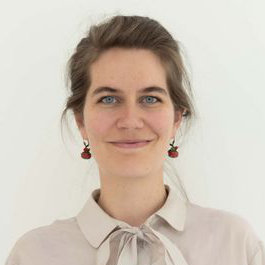
In this FAU LMQ People Spotlight, we interviewed our member Flore Kunst, who leads a Lise Meitner Research group at the Max Planck Institute for the Science of Light since 2024, after joining the institute in 2021 as an independent group leader.
What is your research topic?
My research focuses on non-Hermitian topological phenomena. While most theoretical research focusses on studying systems isolated from their surroundings, we take a more realistic perspective by taking environmental effects such as the gain and loss of energy into account by using so-called non-Hermitian descriptions. In my group, we study these systems through the lens of topology revealing a dramatic enrichment of in the phenomenology of topological phases.
How is your research linked to the research foci of the FAU LMQ?
Where there are photons, there is loss. Particularly in the context of light-matter interactions, non-Hermitian descriptions are a powerful tool to describe the dynamics of photons and electrons in the system.
Why exactly this topic/these topics?
Topological phases of matter are fascinating phases in solid-state materials, where the properties of the system are captured by a global instead of a local order parameter. Adding the ingredient of non-Hermiticity to this picture has led to an enrichment of topological phenomena, such as the piling up of all states on the boundaries known as the non-Hermitian skin effect and the appearance of defective degeneracies known as exceptional points. I am driven by understanding these fascinating phenomena better and investigating how the picture of non-Hermitian physics helps improve our understanding of physics in general.
Who in the Profile Center do you hope to collaborate with in the future?
Currently, I am already collaborating with a few members in the LMQ: Pascal Del’Haye, Hanieh Fattahi, and Birgit Stiller, and am starting to collaborate with Claudiu Gennes. I also hope to collaborate with Kai Phillip Schmidt, Janina Maultzsch, Daniele Fausti and Philipp Hansmann amongst others.
When I am not working as a scientist, then …
I spend time with my children. In the odd hours, where I have some time to myself, I enjoy reading, knitting and crocheting.
Do you have a secret talent?
I am quite an okay field hockey player. I even once won the Swedish field hockey championships as captain to the team in the tiny outdoor competition that exists in Sweden.
What does a typical day in your working life look like?
I usually start the day by going through my emails. On most of the days, when I am not traveling, I have meetings with members of my group, (online) meetings with my collaborators and attend seminars. I very much enjoy discussing physics with others and coming to new realizations and ideas. One important part of the day is also to drink a coffee together with my group members and catch up.
Where do you see the FAU LMQ in 5 or 10 years?
The power of the FAU LMQ is its interdisciplinary character. Through uniting physicists, chemists, computer scientists and potentially even biologists, I envision this center to move the field of light-matter quantum systems in unexpected and exciting new directions.

In this FAU LMQ People Spotlight, we interviewed our member Flore Kunst, who leads a Lise Meitner Research group at the Max Planck Institute for the Science of Light since 2024, after joining the institute in 2021 as an independent group leader.
What is your research topic?
My research focuses on non-Hermitian topological phenomena. While most theoretical research focusses on studying systems isolated from their surroundings, we take a more realistic perspective by taking environmental effects such as the gain and loss of energy into account by using so-called non-Hermitian descriptions. In my group, we study these systems through the lens of topology revealing a dramatic enrichment of in the phenomenology of topological phases.
How is your research linked to the research foci of the FAU LMQ?
Where there are photons, there is loss. Particularly in the context of light-matter interactions, non-Hermitian descriptions are a powerful tool to describe the dynamics of photons and electrons in the system.
Why exactly this topic/these topics?
Topological phases of matter are fascinating phases in solid-state materials, where the properties of the system are captured by a global instead of a local order parameter. Adding the ingredient of non-Hermiticity to this picture has led to an enrichment of topological phenomena, such as the piling up of all states on the boundaries known as the non-Hermitian skin effect and the appearance of defective degeneracies known as exceptional points. I am driven by understanding these fascinating phenomena better and investigating how the picture of non-Hermitian physics helps improve our understanding of physics in general.
Who in the Profile Center do you hope to collaborate with in the future?
Currently, I am already collaborating with a few members in the LMQ: Pascal Del’Haye, Hanieh Fattahi, and Birgit Stiller, and am starting to collaborate with Claudiu Gennes. I also hope to collaborate with Kai Phillip Schmidt, Janina Maultzsch, Daniele Fausti and Philipp Hansmann amongst others.
When I am not working as a scientist, then …
I spend time with my children. In the odd hours, where I have some time to myself, I enjoy reading, knitting and crocheting.
Do you have a secret talent?
I am quite an okay field hockey player. I even once won the Swedish field hockey championships as captain to the team in the tiny outdoor competition that exists in Sweden.
What does a typical day in your working life look like?
I usually start the day by going through my emails. On most of the days, when I am not traveling, I have meetings with members of my group, (online) meetings with my collaborators and attend seminars. I very much enjoy discussing physics with others and coming to new realizations and ideas. One important part of the day is also to drink a coffee together with my group members and catch up.
Where do you see the FAU LMQ in 5 or 10 years?
The power of the FAU LMQ is its interdisciplinary character. Through uniting physicists, chemists, computer scientists and potentially even biologists, I envision this center to move the field of light-matter quantum systems in unexpected and exciting new directions.