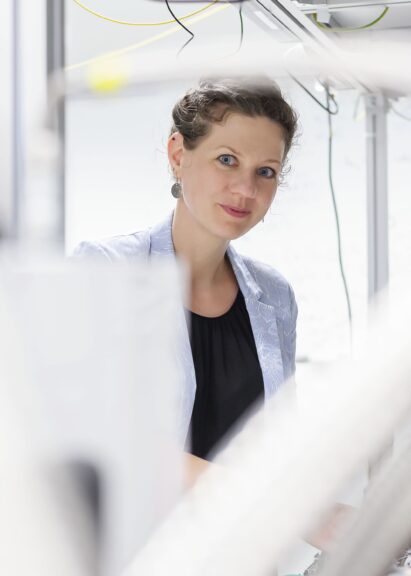
In this FAU LMQ People Spotlight, we interviewed our member Birgit Stiller, who leads the Quantum Optoacoustics Group at the Max Planck Institute for the Science of Light and is recently a full professor at the Leibniz University Hannover.
What is your research topic?
My team and I work on the interaction of light and acoustic vibrations in waveguide structures, such as optical fibers or waveguides on integrated photonic chips. This research is located at the interface of nonlinear optics and quantum optics and has applications in quantum technologies, photonic neuromorphic computing, sensing and communications. Our recent research highlights are building blocks for optoacoustic neural networks, cooling of traveling acoustic waves, photon-phonon entanglement and exploration of exotic thermodynamic regimes.
How is your research linked to the research foci of the FAU LMQ?
We are experimentalists and the success of our experiments depends to a large extend on parameters like coherence, large cooperativities, strong light-matter interactions – all topics that many members at the LMQ are concerned about. Moreover, we work towards applications in quantum technologies in which also several PIs in the center are involved in.
Why exactly this topic/these topics?
The combination of light and acoustics offers very interesting approaches because both types of waves “live in different worlds”. The physics of optical waves interacting with acoustic or mechanical vibrations links two very different domains in terms of frequency, velocity, dissipation and other properties. A prominent example is to transfer information from an optical carrier to an acoustic carrier and achieve a 100.000 times slower information flow than before. Another example is that acoustic waves are a lot more sensitive to the environment than light, for instance pressure or temperature changes. Since this interaction can happen in the classical as well as in the quantum domain, there is a plethora of applications to explore. That is why I am fascinated by it.
Who in the Profile Center do you hope to collaborate with in the future?
There are many! With several PIs we have already worked in the past and enjoy successful on-going collaborations such as Claudiu Genes, Flore Kunst, Pascal Del’Haye, Christoph Marquardt, Bernhard Schmauss, and more, both with theorists and experimentalists. But I’m also interested in getting in touch with more PIs, for instance the more recent PIs joining the center. Especially in the directions of solid-state physics and thermodynamics, we are looking forward to collaborations.
When I am not working as a scientist, then …
I like spending time with my family – I have two young kids – and I am passionate for dancing.
Do you have a secret talent?
A secret talent might be that I paint (acrylics).
What does a typical day in your working life look like?
After dropping off the kids, the day typically starts off with coffee and continues with many meetings and discussions. Depending on if I am in Erlangen or in Hannover, I give my lectures, organize the newly started lab or discuss recent lab results. From 5 to around 9pm is family time and after that often some more emails or paper corrections wait for me. Don’t worry, I don’t expect answers at that late time of the day!
Where do you see the FAU LMQ in 5 or 10 years?
A wise person said that many big things start with founding something like a center, so I hope the FAU LMQ will be the founding stone of a larger research infrastructure or even institute.
(Image on the top: MPL / Stephan Spangenberg)

In this FAU LMQ People Spotlight, we interviewed our member Birgit Stiller, who leads the Quantum Optoacoustics Group at the Max Planck Institute for the Science of Light and is recently a full professor at the Leibniz University Hannover.
What is your research topic?
My team and I work on the interaction of light and acoustic vibrations in waveguide structures, such as optical fibers or waveguides on integrated photonic chips. This research is located at the interface of nonlinear optics and quantum optics and has applications in quantum technologies, photonic neuromorphic computing, sensing and communications. Our recent research highlights are building blocks for optoacoustic neural networks, cooling of traveling acoustic waves, photon-phonon entanglement and exploration of exotic thermodynamic regimes.
How is your research linked to the research foci of the FAU LMQ?
We are experimentalists and the success of our experiments depends to a large extend on parameters like coherence, large cooperativities, strong light-matter interactions – all topics that many members at the LMQ are concerned about. Moreover, we work towards applications in quantum technologies in which also several PIs in the center are involved in.
Why exactly this topic/these topics?
The combination of light and acoustics offers very interesting approaches because both types of waves “live in different worlds”. The physics of optical waves interacting with acoustic or mechanical vibrations links two very different domains in terms of frequency, velocity, dissipation and other properties. A prominent example is to transfer information from an optical carrier to an acoustic carrier and achieve a 100.000 times slower information flow than before. Another example is that acoustic waves are a lot more sensitive to the environment than light, for instance pressure or temperature changes. Since this interaction can happen in the classical as well as in the quantum domain, there is a plethora of applications to explore. That is why I am fascinated by it.
Who in the Profile Center do you hope to collaborate with in the future?
There are many! With several PIs we have already worked in the past and enjoy successful on-going collaborations such as Claudiu Genes, Flore Kunst, Pascal Del’Haye, Christoph Marquardt, Bernhard Schmauss, and more, both with theorists and experimentalists. But I’m also interested in getting in touch with more PIs, for instance the more recent PIs joining the center. Especially in the directions of solid-state physics and thermodynamics, we are looking forward to collaborations.
When I am not working as a scientist, then …
I like spending time with my family – I have two young kids – and I am passionate for dancing.
Do you have a secret talent?
A secret talent might be that I paint (acrylics).
What does a typical day in your working life look like?
After dropping off the kids, the day typically starts off with coffee and continues with many meetings and discussions. Depending on if I am in Erlangen or in Hannover, I give my lectures, organize the newly started lab or discuss recent lab results. From 5 to around 9pm is family time and after that often some more emails or paper corrections wait for me. Don’t worry, I don’t expect answers at that late time of the day!
Where do you see the FAU LMQ in 5 or 10 years?
A wise person said that many big things start with founding something like a center, so I hope the FAU LMQ will be the founding stone of a larger research infrastructure or even institute.
(Image on the top: MPL / Stephan Spangenberg)