There is a growing interest in time and frequency (T&F) distribution in networks that can be attributed to various factors: The application of optical clocks for monitoring geophysical phenomena including ground movements, earthquakes, tsunamis, and other climate-related events. In addition there are also heightened security requirements and concerns over potential failures in satellite timing and navigation systems. Furthermore, the emergence of quantum services, which necessitate synchronization for ensuring stable visibility of coincidence counts between interfering photons underscores the urgency of implementing T&F services over the network for research and education. As part of the GÉANT project in its current phase GN5-2, the National Research and Education (NREN) providers, each with their own user communities, geographical challenges and local conditions are exploring and implementing solutions not only nationally but also within the context of a European-wide infrastructure and the GÉANT backbone to ensure the delivery of these services for years to come.
In addition to its responsibilities as the University’s IT service provider the RRZE supports R&D projects. These projects are typically acquired through the German Research Network Association (DFN), the Federal Ministry of Research, Technology and Space (BMFTR), or the EU, and in the area of networking are carried out by the Research Group for Networks of the Communications Department of the RRZE. The group has been working for the European project “GÉANT” in its framework programs “Horizon 2020” and “Horizon Europe” throughout all project phases with a current focus in GN5-2 on fiber-sensing, optical time and frequency distribution, quantum technologies and network programmability.
For more information, see their publication in Quantum Computing, Communication, and Simulation V:
Steps towards integrating isolated parts and developing a joint time and frequency distribution fiber infrastructure in Europe,
J. Vojtech, G. Roberts, V. Smotlacha, T. Novak, M. Spacek, E. Andriantsarazo, O. Havlis, M. Slapak, R. Lui, J. Roztocil, S. Naegele-Jackson, J. Kronjaeger, J.-O. Gaudron, and K. Turza
Proc. SPIE 13391, Quantum Computing, Communication, and Simulation V, 1339107 (19 March 2025)

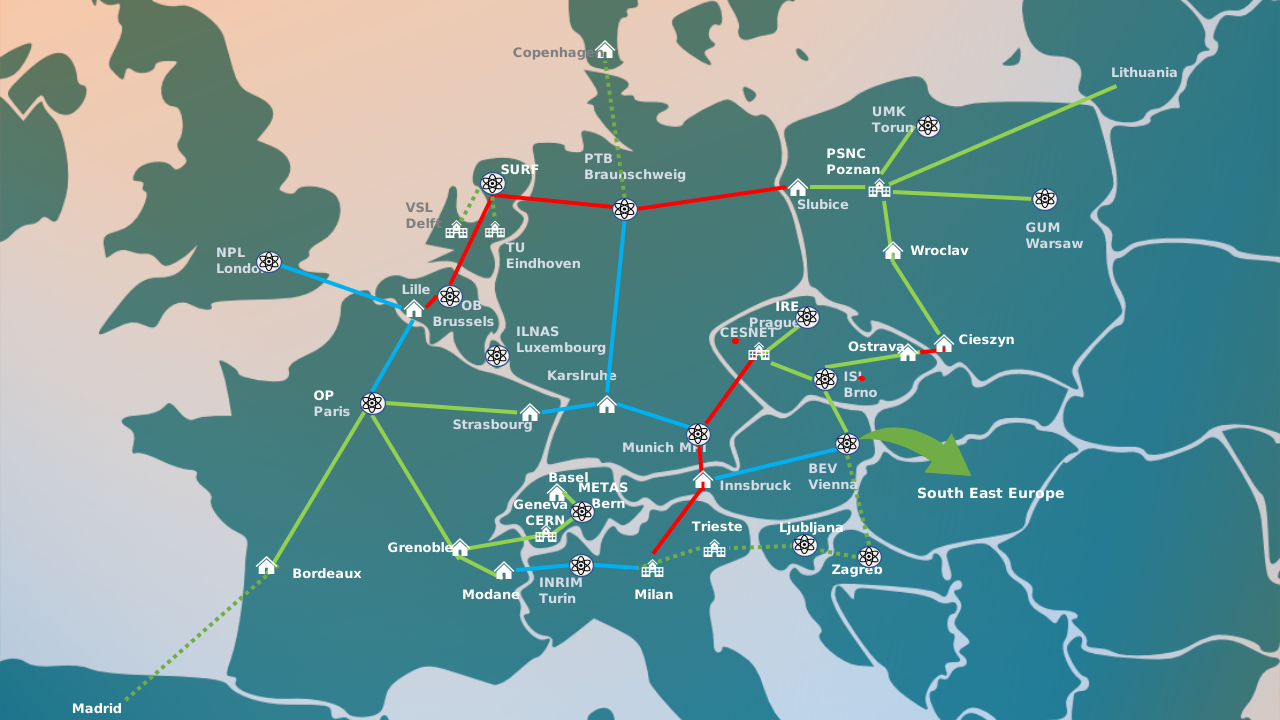
There is a growing interest in time and frequency (T&F) distribution in networks that can be attributed to various factors: The application of optical clocks for monitoring geophysical phenomena including ground movements, earthquakes, tsunamis, and other climate-related events. In addition there are also heightened security requirements and concerns over potential failures in satellite timing and navigation systems. Furthermore, the emergence of quantum services, which necessitate synchronization for ensuring stable visibility of coincidence counts between interfering photons underscores the urgency of implementing T&F services over the network for research and education. As part of the GÉANT project in its current phase GN5-2, the National Research and Education (NREN) providers, each with their own user communities, geographical challenges and local conditions are exploring and implementing solutions not only nationally but also within the context of a European-wide infrastructure and the GÉANT backbone to ensure the delivery of these services for years to come.
In addition to its responsibilities as the University’s IT service provider the RRZE supports R&D projects. These projects are typically acquired through the German Research Network Association (DFN), the Federal Ministry of Research, Technology and Space (BMFTR), or the EU, and in the area of networking are carried out by the Research Group for Networks of the Communications Department of the RRZE. The group has been working for the European project “GÉANT” in its framework programs “Horizon 2020” and “Horizon Europe” throughout all project phases with a current focus in GN5-2 on fiber-sensing, optical time and frequency distribution, quantum technologies and network programmability.
For more information, see their publication in Quantum Computing, Communication, and Simulation V:
Steps towards integrating isolated parts and developing a joint time and frequency distribution fiber infrastructure in Europe,
J. Vojtech, G. Roberts, V. Smotlacha, T. Novak, M. Spacek, E. Andriantsarazo, O. Havlis, M. Slapak, R. Lui, J. Roztocil, S. Naegele-Jackson, J. Kronjaeger, J.-O. Gaudron, and K. Turza
Proc. SPIE 13391, Quantum Computing, Communication, and Simulation V, 1339107 (19 March 2025)