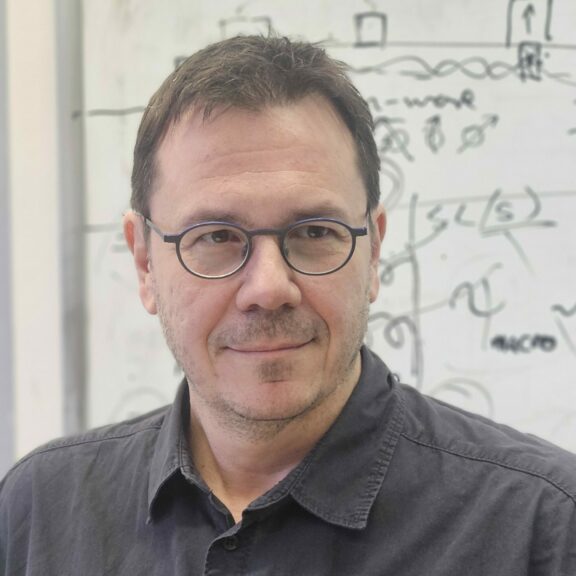
In this FAU LMQ People Spotlight, we interviewed our member Vojislav Krstić, who is holder of the Professorship for Applied Physics since October 2013 and Head of The Electronic Nano and Quantum Materials Group at the Department of Physics at the FAU.
What is your research topic?
Novel and unconventional electronic systems and states in complex solid state matter such as two-dimensional topological insulators and layered materials, one-dimensional wide bandgap semiconductors and chiral nanostructures (e.g. nanohelices, bi-chiral topological insulators). The focus is the interplay of symmetry(-breaking) and nanoscale to achieve and study experimentally newly emerging correlated and/or topological phases, magnetochiral anisotropies and high-temperature stable qubits not naturally present in the (untreated) electronic systems. Experimentally we use predominantly electrical transport at varying temperature and applied magnetic field as well as optical techniques such as micro-Raman and circular dichroism measurements.
How is your research linked to the research foci of the FAU LMQ?
Material systems like superconductors, (ensembles of) individual molecules or plasmonic nanostructures, colour-centres, 2D layered materials etc. have been shown to be promising candidates for application and realisation of quantum-technological platforms. However, several other materials systems are increasingly gaining relevance and attract the research community because of their exquisite tunability and theorized much higher resilience to external processes deteriorating quantum coherence of associated states. These material systems include, deliberately designed, on the nanoscale tailorable (quantum confined) metafilms/surfaces (incl. intrinsic symmetry-breaking), macroscopic wavefunction materials (e.g. density waves), and topological materials (e.g. nanostructured topological insulators).
My research interest lies on such material systems and their electronic and optical quantum-properties and -functionalities under external stimulus such as light-incidence (and emission), temperature-variation and external (electric, magnetic) field-exposure. Therefore, my research activities provide new and complementary aspects to the mission and vision of the FAU Profile Center LMQ.
Why exactly this topic/these topics?
The potential of any material for application in (future) quantum technologies lies in its ability to develop and maintain quantum coherent states (preferably at non-cryogenic temperatures) and how to address them, which can be either via light or electrically.
The latter is preferred if thinking about a broader application within society, ours is and continues to be built on electricity. To bring all aforementioned aspects together topological phases and macroscopic wavefunctions themselves, and from these arising new exotic quasi-particles, such as anyons, are highly promising building blocks for qubits and quantum technological devices in general.
Who in the Profile Center do you hope to collaborate with in the future?
Hopefully with everybody, however, in the short- to mid-term Philipp Hansmann, Flore Kunst, Daniele Fausti, Alexander Schneider, Janina Maultzsch, Claudiu Genes, and Kai Schmidt.
When I am not working as a scientist, then …
I love to cook.
Do you have a secret talent?
Not aware of, except maybe cooking, maybe martial arts.
What does a typical day in your working life look like?
Early morning up, coffee, cycling to office, coffee, and then, depending if during teaching time, first lectures/seminars/tutorials (including preparation), coffee, then informal exchange with the people in my group on results and progresses and upcoming new ideas. Coffee, then paper and project proposal writing and/or conceptualization. Inbetween meetings with students and colleagues.
Where do you see the FAU LMQ in 5 or 10 years?
The LMQ has gathered together a very powerful team of scientists. I would like to see that in 5 to 10 years the FAU LMQ has developed into a university wide, overarching research hub at the point where solid-state electronics overlaps coherently with optics under the umbrella of future quantum physics and technology with national and international influence. This achieved by synergetic, collaborative research endeavors.

In this FAU LMQ People Spotlight, we interviewed our member Vojislav Krstić, who is holder of the Professorship for Applied Physics since October 2013 and Head of The Electronic Nano and Quantum Materials Group at the Department of Physics at the FAU.
What is your research topic?
Novel and unconventional electronic systems and states in complex solid state matter such as two-dimensional topological insulators and layered materials, one-dimensional wide bandgap semiconductors and chiral nanostructures (e.g. nanohelices, bi-chiral topological insulators). The focus is the interplay of symmetry(-breaking) and nanoscale to achieve and study experimentally newly emerging correlated and/or topological phases, magnetochiral anisotropies and high-temperature stable qubits not naturally present in the (untreated) electronic systems. Experimentally we use predominantly electrical transport at varying temperature and applied magnetic field as well as optical techniques such as micro-Raman and circular dichroism measurements.
How is your research linked to the research foci of the FAU LMQ?
Material systems like superconductors, (ensembles of) individual molecules or plasmonic nanostructures, colour-centres, 2D layered materials etc. have been shown to be promising candidates for application and realisation of quantum-technological platforms. However, several other materials systems are increasingly gaining relevance and attract the research community because of their exquisite tunability and theorized much higher resilience to external processes deteriorating quantum coherence of associated states. These material systems include, deliberately designed, on the nanoscale tailorable (quantum confined) metafilms/surfaces (incl. intrinsic symmetry-breaking), macroscopic wavefunction materials (e.g. density waves), and topological materials (e.g. nanostructured topological insulators).
My research interest lies on such material systems and their electronic and optical quantum-properties and -functionalities under external stimulus such as light-incidence (and emission), temperature-variation and external (electric, magnetic) field-exposure. Therefore, my research activities provide new and complementary aspects to the mission and vision of the FAU Profile Center LMQ.
Why exactly this topic/these topics?
The potential of any material for application in (future) quantum technologies lies in its ability to develop and maintain quantum coherent states (preferably at non-cryogenic temperatures) and how to address them, which can be either via light or electrically.
The latter is preferred if thinking about a broader application within society, ours is and continues to be built on electricity. To bring all aforementioned aspects together topological phases and macroscopic wavefunctions themselves, and from these arising new exotic quasi-particles, such as anyons, are highly promising building blocks for qubits and quantum technological devices in general.
Who in the Profile Center do you hope to collaborate with in the future?
Hopefully with everybody, however, in the short- to mid-term Philipp Hansmann, Flore Kunst, Daniele Fausti, Alexander Schneider, Janina Maultzsch, Claudiu Genes, and Kai Schmidt.
When I am not working as a scientist, then …
I love to cook.
Do you have a secret talent?
Not aware of, except maybe cooking, maybe martial arts.
What does a typical day in your working life look like?
Early morning up, coffee, cycling to office, coffee, and then, depending if during teaching time, first lectures/seminars/tutorials (including preparation), coffee, then informal exchange with the people in my group on results and progresses and upcoming new ideas. Coffee, then paper and project proposal writing and/or conceptualization. Inbetween meetings with students and colleagues.
Where do you see the FAU LMQ in 5 or 10 years?
The LMQ has gathered together a very powerful team of scientists. I would like to see that in 5 to 10 years the FAU LMQ has developed into a university wide, overarching research hub at the point where solid-state electronics overlaps coherently with optics under the umbrella of future quantum physics and technology with national and international influence. This achieved by synergetic, collaborative research endeavors.